
Our History
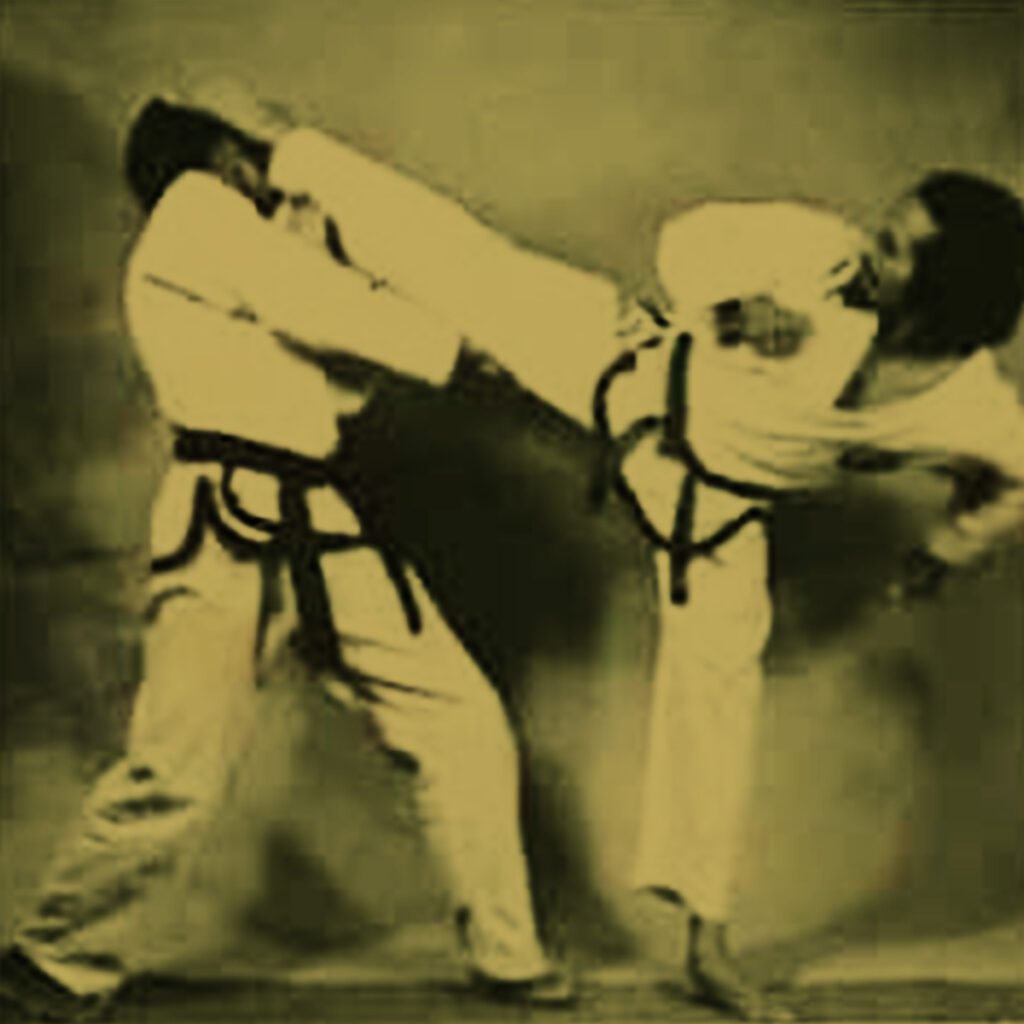
Master King, demonstrating one of his hook kicks.
Evidence has shown that Taekwondo has been practiced in Jamaica as far back as 1969.
Sidekicks Taekwondo Club came out of the National Taekwondo Institute, a school started by Sabumnim Garth “Noel” King, a fourth-degree ITF black belt instructor who was taught by Professor and Master Dan Ja Yang at Howard University Taekwondo Club in the USA. This club was formed in 1967 and breeds legends, and some of the black belts earned medals at the Olympics and world championships, including Sabumnim King. Sabumnim King began teaching the WTF system in the mid-’80s to the National Taekwondo Institute club after his instructor made the transition from ITF to WTF. Sabumnim King, however, in 1986 resigned from teaching Taekwondo full time to take directorial responsibility in Computer Business Systems, a business that he had started that needed his efforts full time.
All the schools were eventually closed except the Kingston YMCA branch (there is, however, another ITF-based school—the Jamaica Taekwondo Association being run). This branch was taught by 1st-degree black belt Delroy McDowell, a student with great enthusiasm and a love for martial arts. The school was kept alive out of this love for Taekwondo and traditions taught to him by Sabumnim King, coupled with a deep commitment to working with the YMCA volunteer activities program. The school has gone through many adversities since Mr. McDowell ran the school on his own without continued guidance from a senior instructor or master until time, love, and perseverance brought him to Sabumnim Maurice Orange in the summer of 1988.
Maurice Orange, then a 4th-degree senior ATA/STF black belt and regional vice president.
Photo with Taekwondo instructors in Jamaica. Mr. McDowell was impressed by the Songahm tradition that was introduced to and taught to him. He traveled to San Diego for the first time to be exposed to Taekwondo as practiced by the American Taekwondo Association and, primarily, to retest for his first-degree black belt under ATA’s Songahm system. This was the beginning of a new tradition born out of Sabum Orange’s love for the extension of Taekwondo fellowship to Jamaica. Mr. McDowell later met Grand Master H.U. Lee at his 2nd-degree testing in Las Vegas, Nevada, in 1992.
Maurice Orange resigned from the American Taekwondo Association. His resignation gave birth to what came to be known as Sidekicks Taekwondo. Mr. McDowell and the students who continue to practice with this club remain loyal to Master Orange. Master Orange continues to direct and support the Sidekicks Taekwondo Association out of his office at the Sidekicks Martial Arts Academy in San Diego, California. Maurice Orange is the founder and grand master of Sidekicks Taekwondo.
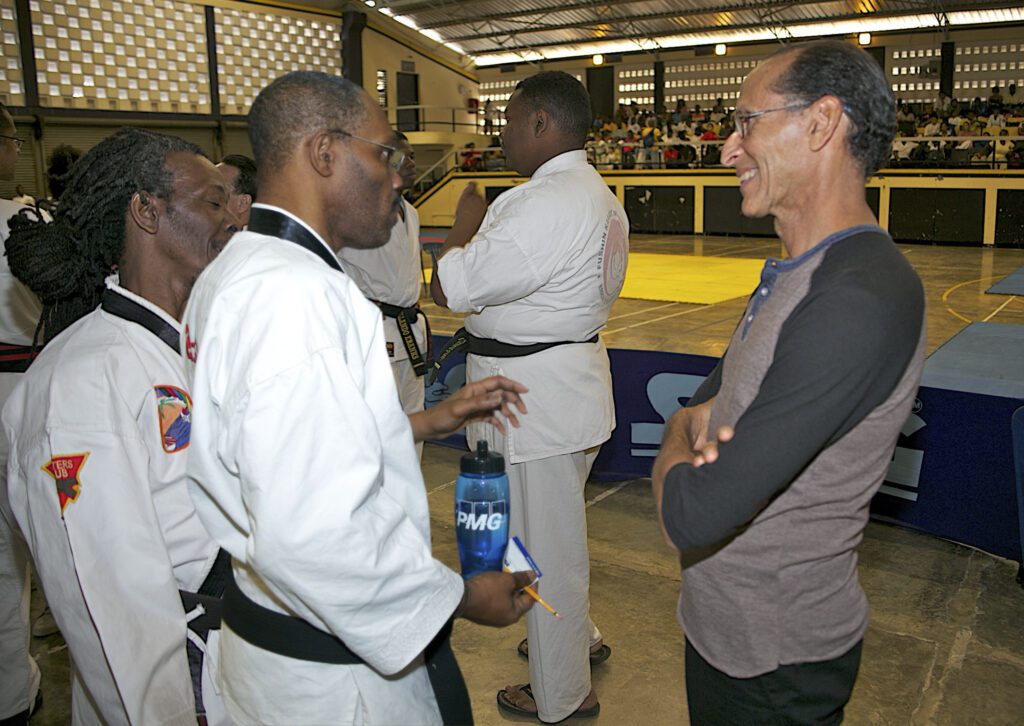
Master King, Sabumnim McDowell, and Sabumnim Harris at a Sadekicks national tournament.
The quality of instruction could be surmised in a single word: professionalism. All instructors are black belts trained under the direct supervision of Sabumnim Delroy McDowell, a 4th Degree Black Belt and senior instructor of the SideKicks Taekwondo Association, formerly Songahm. This certification, representing over 2000 hours of training and study, ensures that only professional and qualified instructors teach at our schools.
The SideKicks Martial Arts Academy was founded and is headed by Grandmaster Maurice Orange, 8th Degree Black Belt, who is in residence at our International Headquarters in San Diego, California.
Mr. Orange personally supervises all international certifications for instructors testing for black belts and instructor training classes/camps to ensure a measure of “quality control” in all member Taekwondo schools. Master Orange brings over thirty (30) years of martial arts experience to our students
S.T.A. TAEKWONDO.
Taekwondo allows a woman to emphasize many of her natural physical strengths, such as the power in her legs, while learning a method of self-defense efficient against a much larger opponent.
Besides gaining a sense of individual accomplishment often lacking in team sports, most children will improve their poise, self-confidence, and self-discipline, which often carries over to their home life and school work.
Our Student OATH
I am a student of TAEKWONDO.
I strive to live honorably through peaceful means
I have the courage to face all challenges, and the strength to conquer
I respect my juniors and seniors and live in harmony with my family, friends, and neighbours
I am dedicated to my physical, mental, and spiritual growth
I am a student of TAEKWONDO.
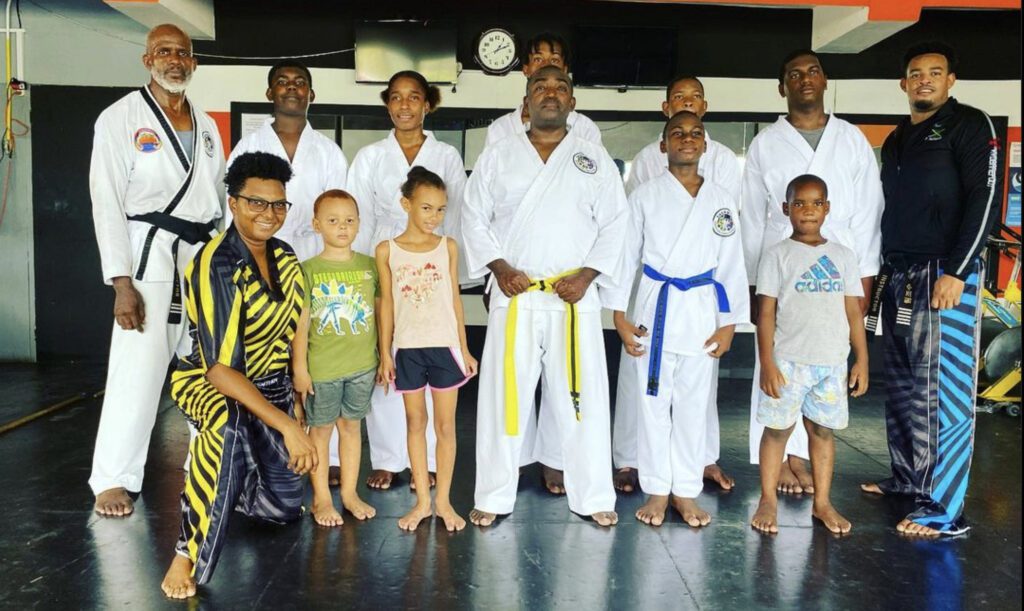

This Taekwondo style emphasizes the development and use of both kicking and hand techniques to their best advantage—which provides greater striking strength in all areas of its techniques. The school has a collective wisdom and experience of over 60 years. The STA Taekwondo style consists of seven sections of physical training that improve students both physically and mentally.
BASICS – element of hand and arm motion.
KICKS – element of foot and leg motion.
FITNESS – evidence of physical fitness
FORMS – individual action.
ONE STEP – practical use of combat techniques.
SPARRING – relatively free combat action.
BREAKING – evidence of power.
These skills are the basis of the organization’s requirements for grading and rank promotion.
The school places most of its emphasis on:
Discipline – training that is expected to produce a controlled behaviour that produces moral and mental improvement in our students.
Honour – Personal integrity maintained without legal or other obligations.
Integrity – Rigid adherence to a code of standard values.
Self-control – Control of one’s emotions, desires, or actions by one’s own will.
Self-Esteem – Pride in oneself.
Respect – (a) To feel or show a different regard for; to esteem or show esteem. (b) Willingness to show one’s consideration or appreciation.
Pride – Pleasure or satisfaction taken in one’s work or achievements.
Loyalty – Faithfulness to a person, ideal, or custom.
BELT RANK SYSTEM
Sidekick’s belt system uses the colours white, yellow, green, blue, red, and black. A table with an explanation of the rank system can be seen here.

